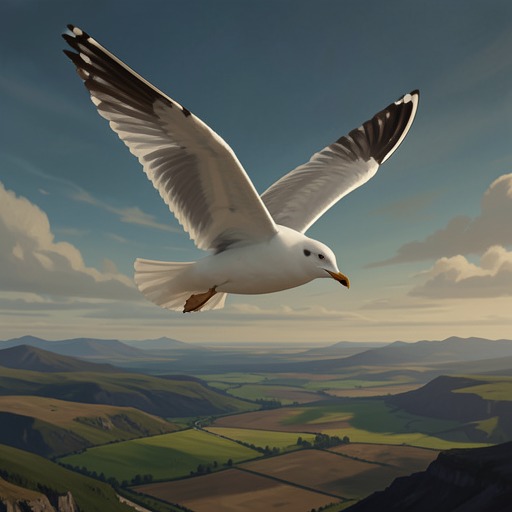
Jonathan pursues flight rather than foraging
Jonathan Livingston SeagullJonathan Livingston Seagull’s pursuit of flight rather than food is the defining choice that carries him from solitary experiments above the sea to a vision of flight as freedom, perfection, and a truth worth teaching. Where most gulls fly from shore to food and back, he treats the air not as a route to survival but as a field of discovery. The choice first separates him from the Flock; in time, it becomes the ground of his return to it.
Identity and First Experiments
At the opening, the sea is crowded with the ordinary business of feeding: a fishing boat chums the water, and a thousand gulls converge on scraps. Far beyond boat and shore, Jonathan practices alone. He lowers his feet, lifts his beak, and bends his wings into a painful curve, trying to slow until the wind is barely felt and the ocean appears still. He stalls and falls, then stretches his wings and tries again. The failure matters because a stall is disgraceful to gulls, yet Jonathan does not accept that convention as a reason to stop.
His interest is not simply in flying as a means of travel. He makes hundreds of low-level glides and discovers that, when he flies less than half a wingspan above the water, he can stay aloft longer with less effort. Instead of the customary splash, his feet skim the surface and leave a long, flat wake; he also practices feet-up landings on the beach, pacing out the length of each slide in the sand. These details make his difference practical as well as inward: he attends to how flight works, testing speed, height, balance, and landing rather than measuring a flight by whether it ends at food.
Conflict with the Feeding Flock
Jonathan’s mother sees the bodily cost of this devotion and asks why he cannot be like the rest of the Flock, why he leaves low flying to pelicans and albatrosses, and why he does not eat. She calls him bone and feathers. Jonathan answers that he wants to know what he can and cannot do in the air. His father, speaking without unkindness, urges him to study food instead: winter is approaching, boats will be fewer, and surface fish will swim deeper. Flying, he reminds Jonathan, cannot be eaten; the reason gulls fly is to eat.
Jonathan obeys for several days, joining the other gulls around piers and fishing boats, screeching and fighting over scraps of fish and bread. The attempt does not persuade him. He drops a hard-won anchovy to an old gull chasing him and recognizes that he would rather spend the time learning to fly. This is not a rejection born of ignorance about food: he has tried the flock’s way and finds that it cannot answer the desire driving him. Soon he is alone at sea again, hungry but happy to be learning.
Technique, Failure, and Discovery
His return to solitary practice turns the desire for flight into a discipline of repeated trials. He studies speed and pushes into steep power-dives from a thousand feet. At seventy miles per hour, the speed at which a wing becomes unstable on the upstroke, he repeatedly loses control. His left wing stalls, he rolls violently, and his recovery sends him into a tumbling spin and a crash into the water. Ten attempts produce ten failures. The sequence gives concrete form to the risk of his chosen study: the Flock’s ordinary flight is safe because it stays within familiar limits, while Jonathan’s experiments make those limits visible through their consequences.
Dripping wet, Jonathan revises his method. He reasons that at high speed he must hold his wings still, flapping only until he reaches fifty miles per hour. From two thousand feet, he dives beak-first and keeps his wings extended and stable once he passes that speed. The correction works: in ten seconds he reaches ninety miles per hour, a world speed record for gulls. But success is not yet mastery. As soon as he begins to pull out and changes the angle of his wings, the same loss of control returns, now with the force of a crash into a hard sea. The breakthrough does not erase danger; it opens another problem to solve.
The later experiments extend from speed into fine control. At terminal velocity, Jonathan reaches 214 miles per hour and discovers that moving a single wingtip feather by a fraction of an inch can produce a smooth, sweeping turn. Moving more than one feather at that speed spins him like a rifle ball, so precision depends on how little he changes. He goes on to discover the loop, slow roll, point roll, inverted spin, gull bunt, and pinwheel. Flight becomes a practice of observation and adjustment: each failure teaches him something, and each achievement reveals another limit beyond it.
From Skill to Perfection
For Jonathan, technical accomplishment never remains an end in itself. In the new world, he is told that heaven is not a place or a time, but being perfect; perfect speed is not a number, because every number imposes a limit. This teaching reframes the ambition behind his experiments. The question is no longer only how fast a gull can fly, but what it means to be free of the limits that make speed measurable.
Chiang teaches Jonathan that thought-speed flight begins with knowing that he has already arrived. Jonathan must stop understanding himself as trapped in a body with a forty-two-inch wingspan and chartable performance, and recognize his nature as unlimited across space and time. The lesson does not arrive through effortless inspiration: Jonathan practices from before sunrise until past midnight and moves not a feather-width from his spot. Chiang insists that understanding, not faith, is required. One day, standing on a shore with his eyes closed, Jonathan grasps the idea that he is a perfect, unlimited gull. He opens his eyes on a different seashore beneath a green sky and twin suns, though Chiang immediately notes that his control still needs work.
The path from physical flight to this realization preserves the book’s emphasis on practice. Jonathan’s first discoveries come from changing the curve of his wings, holding them still at speed, and moving a feather by a fraction. His later lesson likewise requires sustained work and a revised understanding of what he is. Perfection is not presented as a record speed or a finished technique: it is a horizon that keeps demanding learning. Chiang tells him that further work with time can prepare him to understand kindness and love, joining the mastery of movement to a more difficult kind of knowledge.
Return and Teaching
After Chiang disappears, Jonathan repeatedly thinks of Earth and wonders whether another gull there is struggling to break beyond the limits of flight as ordinary travel. He imagines that such a bird might even have been made an Outcast for speaking against the Flock. The thought changes the meaning of his own isolation: what began as a private refusal to live only for feeding can become a way to help another seeker. The more he practices kindness and tries to understand love, the more he wants to return. Jonathan recognizes himself as born to teach, and sees giving another gull a chance to discover the truth for himself as his way of demonstrating love.
The decision does not undo his learning or restore the old measure of success. He returns with the knowledge that he is not merely bone and feather, but an idea of freedom and flight limited by nothing. When he says farewell to Sullivan, he holds in thought an image of gull flocks on a shore in another time and promises that they will meet again. The image connects his mastery of space and time to relationship rather than escape: overcoming distance need not mean abandoning friendship.
Jonathan’s pursuit thus changes scale without losing its original force. It begins in the contrast between a thousand gulls scrambling for breakfast and one gull alone, hungry, testing the air. It passes through failed dives, hard-won technique, and a conception of perfect speed that cannot be reduced to a number. Its consequence is a return oriented toward instruction: flight is freedom not simply because Jonathan can exceed the Flock’s habits, but because what he has learned can be offered to another gull who wants the chance to see for himself.